
 Spinal Decompression vs. Chiropractic Care: What’s the Real Difference?
If you’ve been dealing with back or neck pain for a while, you’ve probably heard both terms thrown around like they mean the same thing: “spinal decompression” and “chiropractic adjustment.” I hear this confusion every week in my Pleasant Hill office, usually from patients who are frustrated because chiropractic care didn’t relieve their pain, or patients who are nervous about signing up for more of the same thing that didn’t work.
I understand that frustration. When you’re dealing with pain that limits your golf swing, your ability to sit through a flight, or even just getting through a workday, you don’t want another vague plan. You want to understand exactly what’s being done to your body and why. So let’s clear this up.
Two Different Tools for Two Different Problems
Chiropractic adjustment and spinal decompression aren’t competing versions of the same treatment. They’re built to address different things.
Chiropractic adjustment is a manual or instrument-assisted technique that targets the small joints of the spine — the facet joints. When those joints lose normal motion or become restricted, an adjustment restores mobility and can reduce the muscle guarding and irritation that comes with it. It’s joint-focused, motion-focused work.
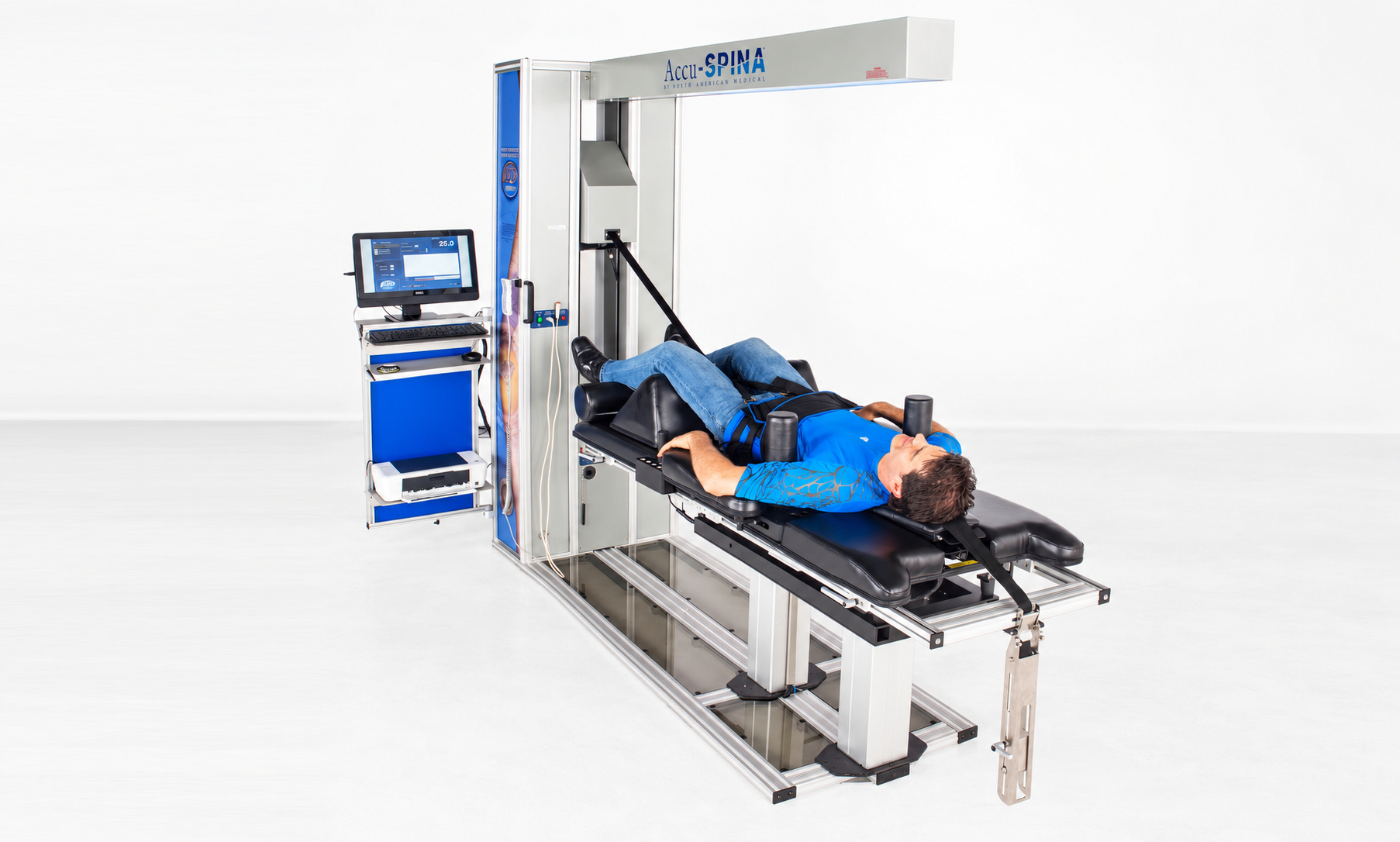
Spinal decompression, specifically the IDD Therapy protocol I use with the Accu-SPINA system, targets something different entirely: the disc itself. Instead of working on joint mobility, IDD Therapy applies a precisely controlled, computer-guided traction force to specific spinal segments. The goal is to gently separate the vertebrae at a targeted disc level, reducing pressure inside the disc and creating room for a bulging or herniated disc to retract, and for compressed nerve roots to get relief.
Think of it this way: if your pain is coming from a joint that’s stuck, an adjustment is the right tool. If your pain is coming from a disc that’s bulging, herniated, or degenerated and pressing on a nerve, you’re dealing with a different mechanical problem — one that joint mobilization alone typically isn’t designed to solve.
Why This Distinction Matters for You
This is exactly why so many patients tell me chiropractic care alone didn’t resolve their symptoms. It’s not that chiropractic “doesn’t work” — it’s that it was being asked to solve a disc problem it wasn’t built for.
A few signs your pain may be disc-related rather than joint-related:
- Pain that radiates down an arm or leg, rather than staying localized
- Numbness or tingling that follows a specific nerve pathway
- Pain that worsens with sitting or certain positions, and eases lying down
- An orthopedist or imaging report has already identified a disc bulge, herniation, or degeneration
- You’ve tried adjustments or physical therapy without lasting relief
If several of these sound familiar, it’s worth having a conversation about whether decompression is the more appropriate path for your specific situation.
What Makes Accu-SPINA Different
The Accu-SPINA system is an FDA-cleared Class II medical device, and what I value most about it clinically is the precision. Unlike older or manual traction methods, it’s computer-controlled — meaning the force, angle, and duration are calibrated to your specific spinal segment rather than applied generically. Each session is logged and adjusted as your case progresses, so the plan evolves with what your spine is actually doing, not a one-size-fits-all schedule.
The Honest Answer: Many Patients Need Both
I’ll be straightforward with you. The good news is that for many of my patients, the most effective plan isn’t “decompression instead of chiropractic.” It’s a coordinated approach: decompression to address the disc-level source of pain, and adjustments or other manual therapy to manage the joint mechanics around it. Neither one promises to eliminate the need for the other, and I won’t tell you a specific outcome is guaranteed before I’ve actually looked at your case since every spine and every MRI is different. You can easily do both chiropractic care and spinal decompression in one appointment.
Not Sure Which Applies to You?
If you’ve been told you might need surgery, the most useful next step is simply having someone look at what’s actually happening in your spine, not just guess from a symptom list.
I’d be glad to personally review your MRI or imaging and walk you through what I see during a free consultation. My office serves patients throughout Pleasant Hill and Walnut Creek.
Schedule your free MRI review with Dr. Dietrick or Call our office at (925) 395-0252.