
 Accu-SPINA vs. DRX9000 vs. DOC: Not All Spinal Decompression Tables Are Built the Same
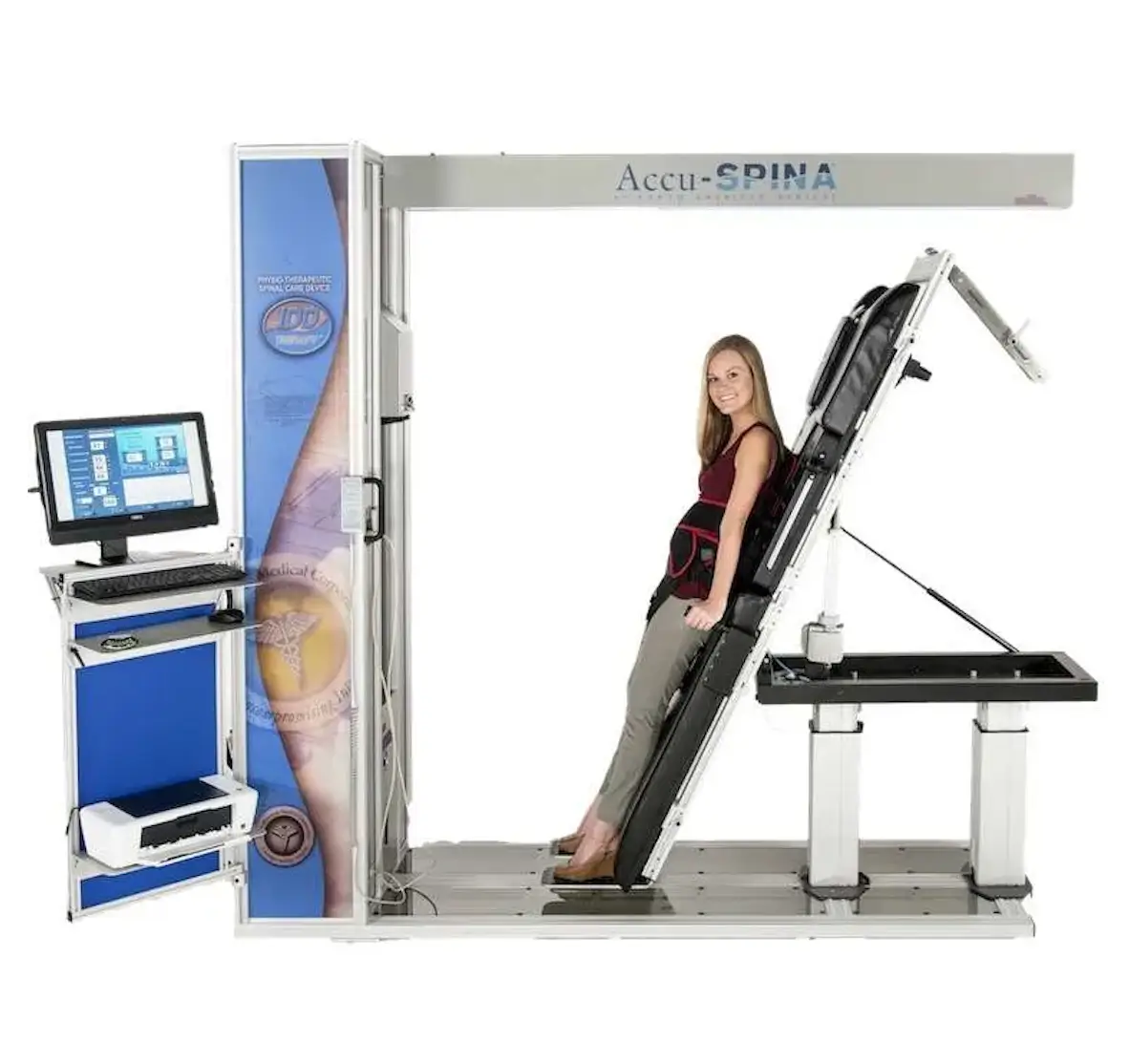
The short answer: The Accu-SPINA, DRX9000, and DOC are all motorized spinal decompression tables designed to take pressure off injured discs, but they are engineered differently. The Accu-SPINA uses a dual-waveform pull with a built-in oscillation, an adjustable treatment angle of up to 30 degrees in the tower, a real-time force sensor, one integrated unit for both the neck and lower back, and a three-layer safety system. The DRX9000 and DOC tables use single-waveform pulls and handle cervical treatment differently. Equipment matters, but your diagnosis, your provider’s experience, and consistent care matter just as much.
If you’ve been researching non-surgical options for a herniated or degenerated disc, you’ve probably noticed something confusing pretty quickly: every clinic seems to say their decompression table is “the best.” You’ve likely seen names like DRX9000, DOC, or Accu-SPINA in different offices around Contra Costa County, and no one explains what actually separates them.
I understand the hesitation. You’re not just choosing a treatment. You’re choosing a piece of equipment that’s going to be pulling on your spine, and you want to be confident it’s the right one for your specific condition. That’s a completely reasonable thing to want to understand before committing your time and money.
So I want to walk you through, in plain terms, how the Accu-SPINA system I use here at Contra Costa Disc Centers in Pleasant Hill differs mechanically from two other tables you’ll commonly encounter: the DRX9000 and the DOC table. This isn’t about badmouthing other equipment. It’s about helping you ask better questions, wherever you end up being treated.
What Does a Spinal Decompression Table Actually Do?
Spinal decompression applies a controlled, calculated pulling force to unload pressure from a compressed or herniated disc. That pull creates negative pressure inside the disc, which may help draw disc material back inward and improve the flow of water, oxygen, and nutrients into the area. In my office, this is delivered as IDD Therapy through the Accu-SPINA, which targets a specific spinal segment rather than pulling generally on the whole spine the way manual traction does.
The therapy is only as good as the machine’s ability to deliver that force precisely, consistently, and safely, session after session. That’s where the differences between tables start to matter clinically, not just cosmetically. It’s also why decompression is a different tool than an adjustment. If you’re curious how the two compare, I explain it in Decompression vs. Chiropractic: Know the Difference.
How Does the Accu-SPINA Compare to the DRX9000 and DOC Tables?
Here are the five features I consider the most clinically relevant when comparing decompression tables:
- Waveform delivery. The Accu-SPINA is built around a dual-waveform design with a patented oscillation component layered into the primary decompression pull. In my experience, that secondary oscillation makes the treatment feel gentler to the patient while the system still calculates and delivers a precise sinusoidal wave. The DRX9000 and DOC tables are single-waveform systems and don’t have that secondary oscillation built in.
- Vertebrae-specific targeting. All three systems offer some form of vertebral level targeting, which is important because a disc problem at L4-L5 needs a different angle and force profile than one at L5-S1. The Accu-SPINA differs in how that targeting is achieved: through an adjustable treatment angle of up to 30 degrees built into the tower of the unit itself, giving a wider and more mechanically direct range of positioning.
- Real-time feedback. The Accu-SPINA uses a built-in sensor that continuously measures pulling force and adjusts accordingly. That means the table makes frequent micro-adjustments during your pull rather than applying one static force and holding it.
- Integrated cervical and lumbar treatment. The Accu-SPINA treats both the cervical and lumbar spine on one integrated unit. The DRX9000 requires a separate dedicated unit for cervical treatment, and the DOC line is configured differently depending on the region being treated. If you have neck pain and lower back pain at the same time, that integration can simplify your treatment plan.
- Safety systems. Every reputable decompression table, including the Accu-SPINA, DRX9000, and DOC, has a patient emergency shut-off. The Accu-SPINA adds a three-layer safety system combining physical, digital, and mechanical fail-safes, along with an emergency release and a medical-grade motor. I want my patients lying on a table where redundancy isn’t an afterthought.
For a side-by-side look at these specifications, you can review the Accu-SPINA feature comparison.
Which Decompression Table Is Best for a Herniated or Degenerated Disc?
I’ll be direct with you. I chose to build my practice around the Accu-SPINA system because of these engineering differences, not because of marketing. When I’m assessing whether decompression as a non-surgical alternative to spine surgery is appropriate for your MRI findings, I need a machine that lets me dial in force, angle, and waveform with real precision. Your L4-L5 disc bulge is not identical to the next patient’s, and a one-size-fits-all pull isn’t good medicine.
That precision matters across the conditions I see most often, including a lumbar disc herniation, degenerative disc disease, sciatica, and a pinched nerve. Each one involves a different segment, a different level of irritation, and a different force profile.
Does the Decompression Machine Alone Guarantee Results?
No, and I want to be fair here. A well-calibrated DRX9000 or DOC table, in the hands of a properly trained provider, can still deliver real clinical benefit. Equipment is only one variable in your outcome. Other important variables include your provider’s experience, patient selection, and treatment consistency.
Independent reviews have also pointed out that marketing for decompression therapy often gets ahead of the research, which is why researchers have urged patients to look past advertising claims. I’d be cautious of anyone, including me, who tells you the machine alone guarantees results. It doesn’t. What it does is give your provider more tools to personalize your care, which is why I pair decompression with supportive care like corrective exercises, cold laser therapy, and lifestyle advice when it fits your case.
Who Should Not Have Spinal Decompression?
Decompression isn’t right for everyone, regardless of which table is used. A federal technology assessment on decompression therapy notes that product literature and study criteria suggest avoiding it in patients with osteoporosis, tumors, infection, spinal instability, or surgical implants. That’s one more reason a careful exam and imaging review should always come before your first session.
What Questions Should You Ask Any Decompression Provider?
Regardless of which table a clinic uses, here’s what I’d encourage you to ask before starting treatment anywhere:
- What specific vertebral level is my treatment targeting, and how was that determined from my imaging?
- How is the force and angle customized to my condition, rather than a standard protocol?
- What safety systems are built into this table?
- How is my progress being measured and tracked across sessions?
If a provider can’t answer these clearly, that’s worth paying attention to. You can also see how I approach these questions with every new patient on our Your First Visit and What to Expect pages.
Let’s Look at Your Case Specifically
Every spine is different, and a list of equipment specs can only tell you so much. If you’re trying to figure out whether spinal decompression, on any table, is a reasonable next step before considering surgery, I’d be glad to personally look at your MRI and talk through what I’m seeing. My office is right here in Pleasant Hill, and I also see patients from Walnut Creek, Concord, Martinez, Lafayette, and throughout Contra Costa County.
Reach out, and let’s have that conversation. Schedule your free MRI review with Dr. Dietrick or call our office at (925) 395-0252.
Frequently Asked Questions About Spinal Decompression Tables
What is the difference between the Accu-SPINA and the DRX9000?
The Accu-SPINA uses a dual-waveform pull with a patented oscillation component, an adjustable treatment angle of up to 30 degrees in the tower, and a real-time force sensor that makes continuous micro-adjustments. The DRX9000 is a single-waveform system and requires a separate dedicated unit for cervical treatment, while the Accu-SPINA treats the neck and lower back on one integrated unit.
What is the difference between the Accu-SPINA and the DOC decompression table?
Both offer vertebral level targeting, but the DOC is a single-waveform system that is configured differently depending on the region being treated. The Accu-SPINA adds a secondary oscillation to its pull, achieves targeting through an angle-adjustable tower, and uses a three-layer physical, digital, and mechanical safety system.
Can the Accu-SPINA treat both neck and lower back disc problems?
Yes. The Accu-SPINA treats both the cervical and lumbar spine on one integrated unit, which can simplify care for patients who have disc-related pain in both the neck and lower back.
Does the type of decompression table affect my results?
It can, because a table’s waveform, targeting, and feedback systems determine how precisely force is delivered to the injured disc. However, equipment is only one variable. Provider experience, accurate diagnosis from your imaging, patient selection, and treatment consistency all play major roles in your outcome.
How do I know if spinal decompression is right for my disc problem?
The best way to know is to have your MRI and exam findings reviewed by a provider who can identify the specific disc level causing your symptoms. At Contra Costa Disc Centers, Dr. Dietrick personally reviews your MRI to determine whether decompression is a reasonable next step for your herniated disc, degenerative disc, sciatica, or pinched nerve.
Who should not have spinal decompression therapy?
Spinal decompression is generally avoided in patients with osteoporosis, spinal tumors, infection, spinal instability, or surgical implants. A thorough exam and imaging review should always be completed before treatment begins.
Do you offer free MRI reviews for patients outside Pleasant Hill?
Yes. Contra Costa Disc Centers is located in Pleasant Hill, CA, and Dr. Dietrick offers free MRI reviews for patients from Walnut Creek, Concord, Martinez, Lafayette, and throughout Contra Costa County. Call (925) 395-0252 or request your evaluation online.